
Tarcoles Bridge Construction: What Every Traveler Must Know
Picture the moment: you have been looking forward to this vacation for months. You flew in to SJO, figured out the customs, and your car rental is all packed and ready to go! There’s just under two hours between you and the beach. Then, 45 miles south of San José, the cars in front of you stop. Then the cars behind you stop. Somewhere ahead, a construction crew is working on the Tarcoles Bridge — and for the next couple of hours, nobody is going anywhere fast.
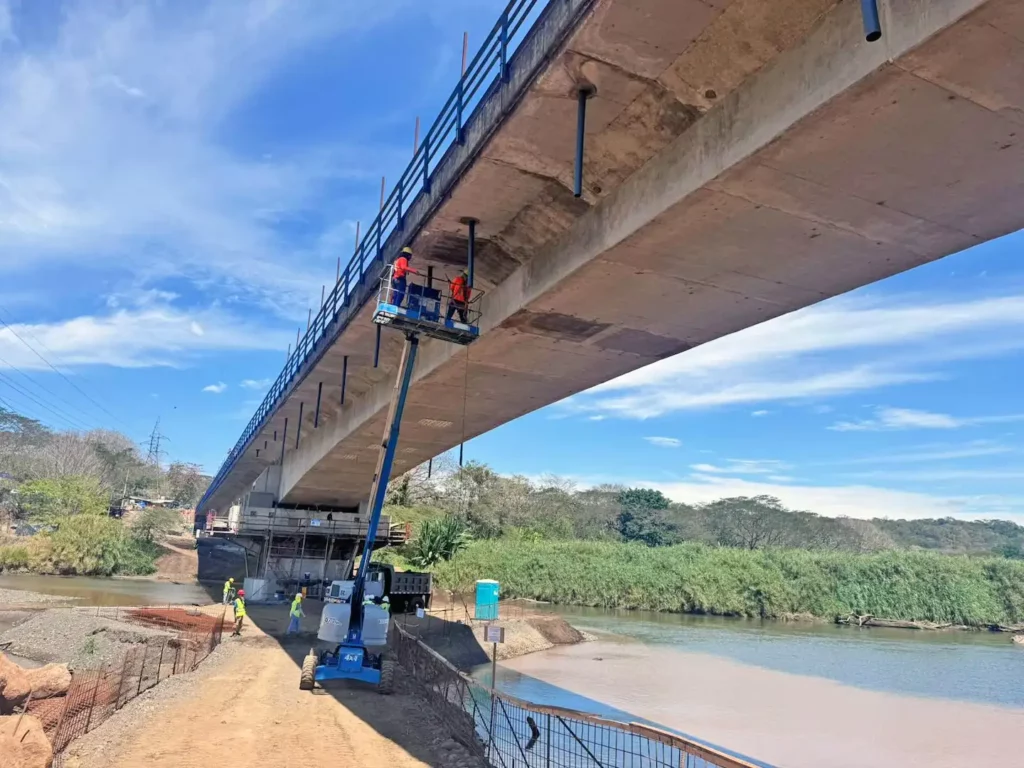
The Tarcoles Bridge construction is one of the most significant travel disruptions currently affecting Costa Rica’s Pacific coast. Launched on July 28, 2025, and projected to run through June 2026, this $6.73 million rehabilitation project has compressed Route 34’s main crossing to a single alternating lane for extended periods. The Costa Rican Ministry of Public Works (MOPT) estimates the bridge generates roughly $1.8 million in daily economic activity — which tells you everything you need to know about why fixing it, and doing it now, was non-negotiable.
This guide gives you the full picture: the history of the bridge, why the repair was urgent, every construction phase that affects your travel window, real updated drive times, and most importantly, how to make smart decisions so your trip to Jacó, Manuel Antonio, Quepos, or the Osa Peninsula does not get eaten alive by a traffic queue.
Skip to…
Why the Tarcoles Bridge Construction Was Unavoidable
Before the current bridge existed, the only way to cross the Tarcoles River was by a small wooden ferry. It held a handful of vehicles at a time, and travelers heading to the coast simply had to wait. When Costa Rica invested in Route 34 aka the Costanera Sur, as the main Pacific artery, a proper bridge was the obvious next step.
Nobody planned for it to become one of Central America’s most visited roadside attractions. The crocodiles did that on their own.
The Bridge That Became an Accidental Icon
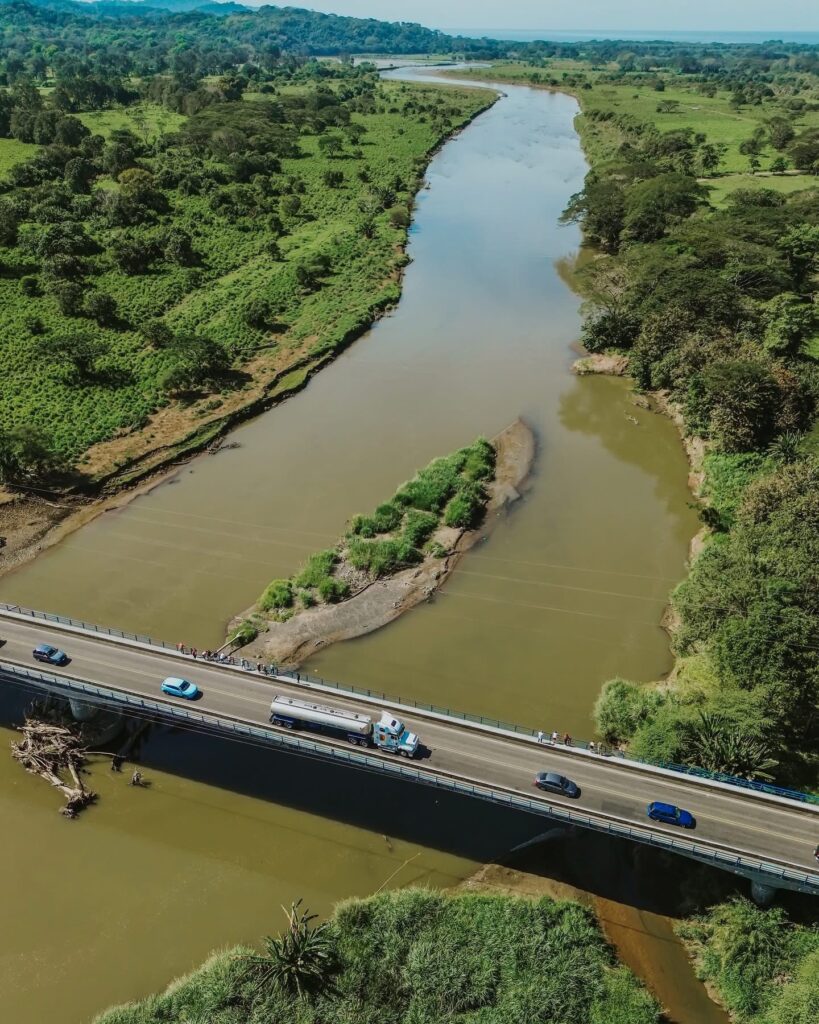
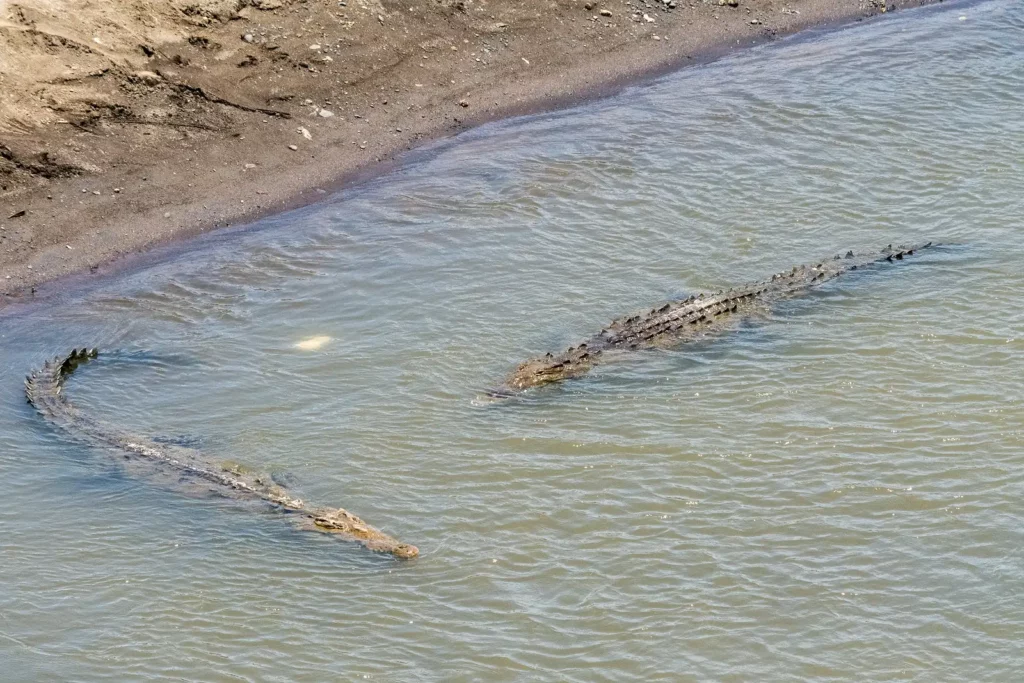
Drivers crossing the bridge started noticing something extraordinary: dozens of massive American crocodiles (Crocodylus acutus) basking on the muddy riverbanks below. Word spread, first among backpackers and locals, then in travel guides, and eventually across social media. The Tarcoles ‘Crocodile Bridge’ became a mandatory stop on every road trip to the Pacific south — a free, wild, five-minute wildlife encounter with some of the largest crocodilians in the Americas.
The Tarcoles River is estimated to support around 2,000 crocodiles, according to figures cited by Costa Rica’s La Nación. Individual animals can exceed 13–16 feet in length. The river corridor also borders Carara National Park, one of the most biodiverse transition zones in Central America, which explains why scarlet macaws, herons, and kingfishers accompany the reptile show.
A Structure at Its Structural Limit
The rehabilitation was not optional. MOPT and CONAVI (Costa Rica’s national road authority) formally classified the Tarcoles Bridge as an ‘imminent risk’ structure due to accelerated deterioration: damage to pile supports, visible cracking in load-bearing components, and a fundamental design flaw — the bridge was not built to withstand a major earthquake.
In a country that sits on the intersection of three tectonic plates, that is not a theoretical concern. A significant seismic event could have disabled the bridge permanently, severing road access between San José and every destination from Jacó to the Osa Peninsula. The government’s own estimate: $1.8 million in daily economic losses if the crossing were to close for an extended period.
The response was a fully funded emergency project: $6.73 million approved through the BCIE Emergency Program for Resilient Infrastructure Reconstruction, contracted to construction company MECO, with a 310-day calendar timeline.
One detail worth knowing: the project contract includes a formal ‘crocodile safety protocol.’ The construction company is required to have a professional biologist and a trained wildlife monitoring team on-site during river-level work. Costa Rica’s MINAE (Ministry of Environment) coordinated temporary relocation of crocodiles from the work zones. Even the construction contract accounts for the wildlife.
This is not routine maintenance. The Tarcoles Bridge rehabilitation is an emergency intervention to prevent structural failure on the most economically critical road crossing in Costa Rica’s Pacific corridor.
The Four Construction Phases and What They Mean for Drivers
Not every month of construction is equally disruptive. The project is organized into four phases with distinct traffic impacts. Knowing which phase overlaps your travel dates gives you a real advantage in planning.
| Phase | Timeline | Traffic Impact | Pedestrian Access |
| Phase 1: Foundations | Jul–Aug 2025 | One-lane alternating 24/7 from Aug 18 | Prohibited (crocodile watching) |
| Phase 2: Pile work | Aug–Nov 2025 | One-lane + nighttime full closures 9 pm–5 am | Prohibited |
| Phase 3: Relief window | Nov 2025–Mar 2026 | Two lanes (one per direction) | Prohibited |
| CURRENT – Phase 4: Superstructure | Feb–Jun 2026 | One-lane alternating 24/7 | Prohibited until project end |
Phase 1 — Foundation Work and Abutments
Work began July 28, 2025, with site preparation: access roads to the bridge piles, debris clearing, and safety signage. Disruptions during this initial period were intermittent as the traffic slowed only when heavy machinery moved between positions.
From August 18, 2025, the bridge moved to full single-lane alternating operation, 24 hours a day. All pedestrian crocodile watching from the bridge was simultaneously prohibited.
Phase 2 — River-Level Work
The technically complex phase involved engineers working directly in the Tarcoles River on the bridge pile reinforcement and erosion protection. This required the crocodile management protocol described above, with wildlife monitors present at all times during in-river operations.
From September 2025, full nighttime road closures (9 p.m. to 5 a.m.) were introduced. There was a maximum of four of them per month, and they were announced in advance. Travelers on late-night drives to the coast needed to monitor MOPT communications or plan around the schedule.
Phase 3 — The Strategic Pause for High Season
Between November 2025 and March 2026, the government made a calculated decision: restore two-lane traffic to reduce disruption during Costa Rica’s peak tourist season. This was the most traveler-friendly window of the entire construction calendar.
NOTE: Holy Week 2026 (March 28–April 5) both lanes will be completely open as well.
Phase 4 — Final Superstructure Work
As of February 23, 2026, the project entered its final and most visible phase: work on the bridge superstructure — the roadway surface and structural elements directly above the river. Single-lane alternating traffic resumed and continues through completion.
As of late February 2026, construction stands at 61% complete according to the Tico Times. A special full closure is planned from May 4–9, 2026 for the installation of the permanent expansion joint, a critical component for long-term durability.
The project’s finish line: June 2026, barring weather disruptions or technical complications.
NOTE to traveleres: Check which phase overlaps your travel dates. If you are traveling in Phase 4 (Feb–Jun 2026), build in at least 90 extra minutes each way.
Real Travel Times During Construction (What Google Won’t Tell You)
Google Maps and Waze reflect live traffic — but they cannot predict the queue that forms at a single-lane construction point with 20 minutes of waiting per cycle. Use these updated benchmarks to build a realistic itinerary.
| Route | Normal Drive Time | With Single-Lane Construction |
| San José → Jacó | ~2.5 hours | ~4.5 hours |
| San José → Manuel Antonio | ~3.5 hours | ~6 hours |
| San José → Quepos | ~3.5 hours | ~6 hours |
| San José → Uvita / Dominical | ~4 hours | ~6.5–7 hours |
| San José → Osa Peninsula | ~5–6 hours | ~7–8+ hours |
Times assume single-lane operation; add 45–90 minutes on Friday afternoons and long holiday weekends.
5 Practical Tips for Crossing the Bridge With Less Pain
- Leave before 8 a.m. or after 6 p.m. Early morning and evening crossings consistently have shorter queues. Midday and Friday afternoons are the worst.
- Use Waze or Google Maps with live traffic enabled. Both apps are accurate in Costa Rica and will alert you to significant backup before you reach the bridge.
- Pack food, water, and patience. A 15-minute wait can stretch to 45 minutes on busy days. A well-stocked car makes it bearable.
- Respect the 30 km/h speed limit. Traffic police (tránsitos) are stationed at the bridge and actively enforce the limit. A fine will make the day worse.
- Build buffer time into both legs of your trip. The return trip on Sundays and holiday Mondays can be just as slow as the outbound Friday drive.
Assessment of Alternate Routes between Central Valley and Central Pacific Coast
Mountain routes through Puriscal or Cerro de la Muerte add 60+ km of winding switchbacks and are genuinely impractical but are still an option if you have the time for a scenic detour.
Drivers coming from San José can take Route 239 from Ciudad Colón through Puriscal, rejoining Route 34 near Esterillos — south of the bridge. It works, but it’s a narrow, partially unpaved mountain road that requires a 4×4, daylight, and dry weather, and still takes more than three hours from San José to reach the coast.
For anyone heading further south — Dominical, Uvita, or the Osa Peninsula — Route 2 over the Cerro de la Muerte through Cartago and San Isidro del General is a legitimate paved alternative that under current construction conditions is actually faster than Route 34 for that specific corridor, though it demands daylight driving and a check for landslide closures before you leave.
Alternate Routes from Other Destinations to Central Pacific
From La Fortuna / Arenal, there is no practical bypass — every paved road funnels through Tarcoles, and the only way to skip it is to fly (roughly 45 minutes to Quepos by private charter).
Travelers coming from Santa Teresa face the Paquera ferry plus the bridge back-to-back; add construction delays and the total door-to-door time to Jacó or Manuel Antonio pushes past eight hours on a bad day — again, a short charter from Cobano or Tambor Airport solves both problems in under 30 minutes. You can also look into renting a boat to take you from anywhere in the Santa Teresa/ Montezuma beach area to the Los Suenos marina. From there you could take a drive to your final destination, but it’s a bit more logistically challenging.
Travelers from Guanacaste planning to go to Jaco or anywhere further south are stuck with traffic at Tarcoles as well, and for most travelers on a standard Pacific coast vacation, there is no road-based solution that restores normal drive times. The bridge is the bottleneck, and until June 2026 it will remain one.
Budget a minimum of 90 extra minutes per leg for any drive through the Tarcoles Bridge during Phase 4 (February–June 2026). On high-traffic dates, two extra hours per leg is a more reliable estimate.
You Can Fly Over the Problem
There is a version of this trip where you leave San José (or La Fortuna), look down at the Tarcoles River from 2,000 feet, spot the crocodiles from the air, and land at your destination before the cars below you have even reached the bridge queue.
That is not a hypothetical. That is what a private charter with Adventure Air looks like on a typical day.
The Numbers That Make the Case
| Route | By Road (with construction) | By Air with Fly Adventure Air |
| San José → Jacó | ~4.5 hours | ~15–20 minutes |
| San José → Manuel Antonio | ~6 hours | ~25–30 minutes |
| San José → Quepos | ~6 hours | ~25–30 minutes |
| San José → Osa Peninsula | ~7–8 hours | ~45–60 minutes |
On a five-day trip, two round-trip drives through the construction zone cost you 10–14 hours of road time. A round-trip flight gives you back almost all of that — time you spend on the beach, on the zip line, or in the hot springs instead.
What Flying With Adventure Air Actually Means
Adventure Air operates private aircraft and helicopter charters from San José to 50+ destinations across Costa Rica. The experience is built around one idea: your time is the most valuable thing on your trip.
- Arrive 15 minutes before departure. No terminals, no TSA, no crowds.
- Fly with only your group. Every flight is private — the aircraft is yours.
- Flexible scheduling. Change your plans without fees up to 48 hours before the flight.
- The flight itself is a highlight. Flying low over the rainforest canopy, Pacific coastline, and river systems is one of the most cinematic experiences Costa Rica offers.
One of our clients who booked a charter from San José to Manuel Antonio put it this way on Tripadvisor: what started as a convenience decision to skip a long drive turned into an excursion — the greatest way to begin a trip. The views were breathtaking, the pilots professional, and the kids could not stop talking about it.
That experience does not happen in traffic on Route 34.
A round-trip charter replaces 10–14 hours of driving with roughly 50–60 minutes of flying. The cost difference between road and air narrows considerably once you account for fuel, tolls, wear, time, and the actual cost of a spoiled vacation day.
How to See the Crocodiles Without Standing on the Bridge
The bridge is off-limits for crocodile watching — and honestly, that opens a better door.
The Bridge Walkway Is Closed for Tourism Until June 2026
Pedestrian access to the Tarcoles Bridge walkway for crocodile viewing has been prohibited since September 2025. The walkway remains open strictly for people crossing from one side to the other — stopping, gathering, and taking photos is not permitted during active construction.
Crocodile watching from the bridge as a tourist activity is suspended for the duration of the project. The construction crew works above and below the bridge, and stopping pedestrians create safety hazards for workers and themselves.
The Boat Safari As a Better Option
Operators in the village of Tárcoles, located just south of the bridge, run boat tours directly into the Tarcoles River. This is not a consolation prize — it is a genuinely superior crocodile experience.
- Eye-level encounters. Instead of peering down from 20 meters above, you approach the crocodiles at water level. The scale of a 13-foot crocodile looks completely different from a small boat.
- Guided context. Local guides explain crocodile behavior, the river’s ecology, and the relationship between the Tarcoles watershed and Carara National Park.
- More wildlife. Scarlet macaws, roseate spoonbills, boat-billed herons, and dozens of other species visible from the water.
- Completely unaffected by construction. The boat tours depart from south of the bridge and operate on a normal schedule regardless of road restrictions.
- Duration and cost. Tours run 45–90 minutes. Expect to pay approximately $30–$60 USD per person depending on operator and duration.
When Does Tarcoles Bridge Construction End?
The official completion date is June 2026, assuming no complications from tropical weather, material delays, or unforeseen structural issues. As of late February 2026, the project was 61% complete, which puts it on a reasonable track toward that deadline.
What the Finished Bridge Will Look Like
The rehabilitation is not cosmetic. When construction ends in June 2026, the Tarcoles Bridge will be:
- Earthquake-resistant. Reinforced to withstand major seismic events, eliminating the single most serious structural vulnerability.
- Erosion-protected. New foundations designed to resist the ongoing hydraulic stress from the Tarcoles River current.
- Better for tourists. Wider pedestrian walkways and improved safety barriers will make crocodile viewing from the bridge safer and more comfortable than at any point in its history.
- Properly lit and marked. New lighting and lane markings for improved nighttime safety.
- Built for decades. The goal of the rehabilitation is to extend the bridge’s operational life well into the future, removing the cycle of emergency repairs.
The Tarcoles Bridge construction is a real disruption but it does not have to define your trip. Know the phases, check traffic before you leave, consider the boat safari over the closed bridge, and if you want the cleanest possible solution — fly over the whole thing.
A 25-minute private charter from San José to Manuel Antonio does not just save you time. It turns the transit itself into one of the best experiences of the trip, with aerial views of rainforest, coast, and river that no road can replicate.
Ready to skip the wait? Book a private charter or helicopter flight with Fly Adventure Air at FlyAdventureAir.com — and arrive at your destination before the traffic queue at Tarcoles has moved an inch.
MOPT Announcement:
https://www.facebook.com/photo/?fbid=1231863032452798&set=a.190432066595905
Tarcoles Bridge Construction FAQs:
Can you still drive through the Tarcoles Bridge in 2026?
Yes. The bridge remains open to traffic throughout construction. Traffic alternates through a single lane 24 hours a day during active construction phases. Expect wait times of 20–45 minutes at the bridge itself, with longer queues on weekends and holidays.
How long does it take to drive from San José to Jacó with the construction?
Approximately four hours during single-lane operation, compared to about two hours under normal conditions. On busy Fridays, add another 45–60 minutes. Leave before 8 a.m. or after 6 p.m. for the shortest crossing times.
Is there a way to reach Manuel Antonio without driving through Tarcoles?
Yes. You can drive through route 236, but prepare your self for a very rough conditions (don’t do it if you a driving a low clearance vehicle) and a long drive. You can also fly! Adventure Air operates private charter flights from San José (SJO) to Manuel Antonio and Quepos in approximately 25–30 minutes. You completely bypass the bridge, Route 34, and any associated traffic. Adventure Air also offers flights to Jacó, Herradura, the Osa Peninsula, and 50+ destinations across Costa Rica.